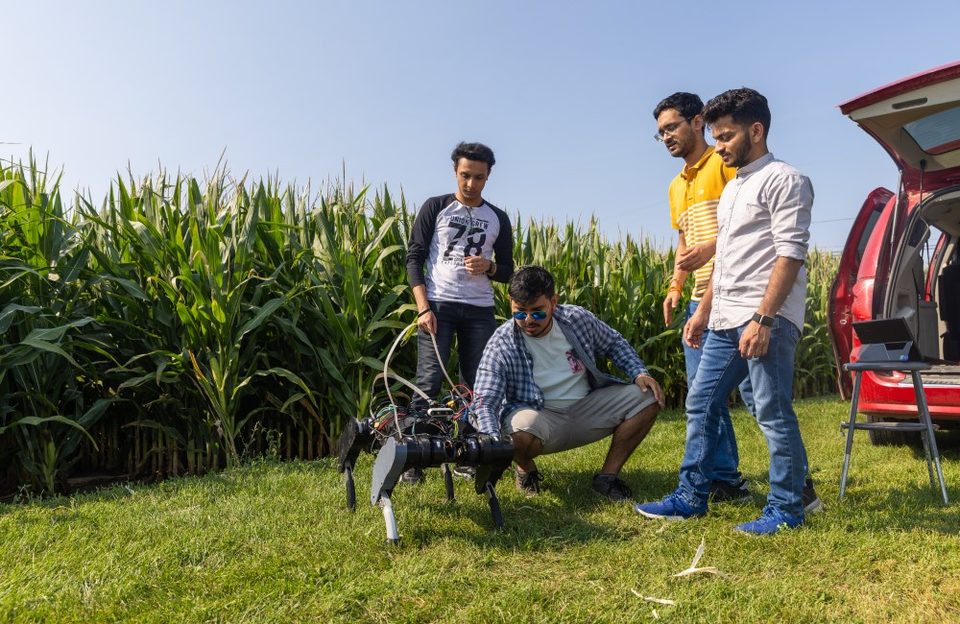
The University of Minnesota reported that its Agricultural Robotics Lab had built OmniAgrobot, a four-legged prototype intended to carry cameras and sensors through agricultural fields. Associate Professor Ce Yang and students began examining the mobility problem in 2021, focusing on real-time wheat disease phenotyping on uneven ground.
The team chose a quadruped configuration to investigate access to spaces and terrain that can be difficult for wheeled vehicles or aerial observation. The October 2024 university report described the platform as being at an early stage, with further development and demonstration still ahead. Its contribution was therefore a research approach to close-range crop observation, rather than evidence of a commercially available robot or proven farm-wide disease-control service.